


Page 12 - UFRA Straight Tip Spring 2021 - Volume 22 Issue 2
P. 12
  What Happens after the Fire Is Out?
Without a doubt, suppression is the most physically demanding, danger- ous, and intense part of a fire response. The stress put on the chief or incident commander during suppression is challenging, but training and experience lead to success. So what happens after the fire is out? Before you were promoted to chief, you finished the overhaul, rolled up hose, replaced the equipment on the engine, filled air bottles, and headed
back to the station. Now that you are the chief, you have more post-fire responsibilities, including investigation, prevention of spoliation, and an awareness of subrogation.
Fire Investigation
Under Utah State law, the local fire chief is responsible to determine or ensure the determination of the origin and cause of every fire. We need to do this for several reasons.
First, we need to determine if there was a criminal act that needs to be referred to law enforcement. Acts of arson, or the intentional setting of fires for any reason, need to be investigated and pursued through law enforcement to stop the arsonist. Without a thorough and complete in- vestigation of every fire, these intentional acts may be overlooked. Also, any fire fatality must be reported to the State Fire Marshal’s Office.
Second, we need to determine if accidental trends are occurring. Are we seeing a rash of fires due to unattended cooking that can be mitigated through a public safety message?
Third, there are financial implications for the home or business owner, their insurance companies, and manufacturers or contractors who
may be involved. Those who may be involved with the cause of the fire through defective equipment or improper installation must have the opportunity to defend themselves against litigation by observing and examining the evidence purported to have caused the fire.
The authority having jurisdiction, or AHJ, does not have to be a qualified fire investigator; he or she only needs to make sure that a qualified inves- tigator conducts the investigation. Most medium to large departments have investigators on staff. Smaller departments can pool resources to get a firefighter qualified to investigate, or they can call the Utah State Fire Marshal’s office to request an investigator free of charge.
Many of the state fire investigators attend chiefs’ meetings, and you may be familiar with the investigator in your area. Insurance companies will also send out private fire investigators to examine the origin and cause of a fire. Be careful not to assume the cause of the fire without thoroughly investigating. A simple stovetop fire may have been an attempt to burn down a house. You may be called by the insurance investigators and asked for relevant details regarding suppression and your findings.
Spoliation
Before the investigator arrives, the incident commander or chief needs to make sure evidence is not destroyed or removed. The destruction of evidence can cause problems for the fire chief. The damage or removal of evidence is referred to as spoliation. NFPA 921 defines spoliation as the loss, destruction, or material alteration of an object or document that is evidence or potential evidence in a legal proceeding by one who has the responsibility for its preservation. Anything that may be responsible for the ignition of the fire needs to be preserved in the location it is found for the investigator.
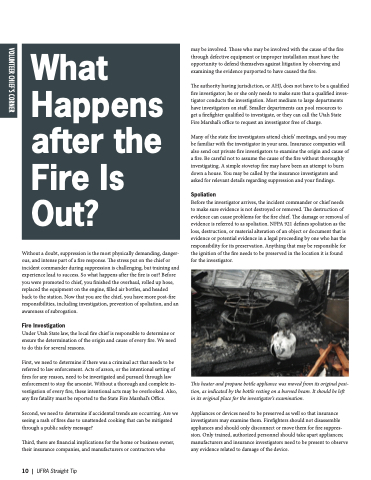
This heater and propane bottle appliance was moved from its original posi- tion, as indicated by the bottle resting on a burned beam. It should be left in its original place for the investigator’s examination.
Appliances or devices need to be preserved as well so that insurance investigators may examine them. Firefighters should not disassemble appliances and should only disconnect or move them for fire suppres- sion. Only trained, authorized personnel should take apart appliances; manufacturers and insurance investigators need to be present to observe any evidence related to damage of the device.
 10 | UFRA Straight Tip
VOLUNTEER CHIEF'S CORNER


