


Page 28 - UFRA Straight Tip Spring 2021 - Volume 22 Issue 2
P. 28
Basic Vehicle
  Door Removal,
EXTRICATION
Revisited
The moment that a vehicle collision occurs, the need to get trapped victims disentangled and transported to definitive medical treatment begins. The best chance of the victims’ survival requires safe, efficient, and quick removal. For this to happen, emergency response organi- zations must invest time and resources into developing well-trained extrication/rescue personnel.
Rapid vehicle design developments require continual modification and revisiting of rescue techniques. The extrication technique we will visit in this segment is a technique designed to remove the side door(s) of a vehicle resting on its wheels.
The most appropriate door removal technique depends on several factors, such as vehicle type, position of vehicle, extent of structural damage, the rescue tools available, and the skill level of the rescue personnel. Remember, the first step may be to unlock the door and open it normally.
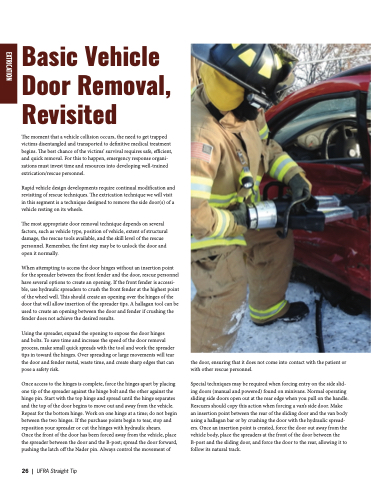
When attempting to access the door hinges without an insertion point for the spreader between the front fender and the door, rescue personnel have several options to create an opening. If the front fender is accessi- ble, use hydraulic spreaders to crush the front fender at the highest point of the wheel well. This should create an opening over the hinges of the door that will allow insertion of the spreader tips. A hallagan tool can be used to create an opening between the door and fender if crushing the fender does not achieve the desired results.
Using the spreader, expand the opening to expose the door hinges
and bolts. To save time and increase the speed of the door removal process, make small quick spreads with the tool and work the spreader tips in toward the hinges. Over spreading or large movements will tear the door and fender metal, waste time, and create sharp edges that can pose a safety risk.
Once access to the hinges is complete, force the hinges apart by placing one tip of the spreader against the hinge bolt and the other against the hinge pin. Start with the top hinge and spread until the hinge separates and the top of the door begins to move out and away from the vehicle. Repeat for the bottom hinge. Work on one hinge at a time; do not begin between the two hinges. If the purchase points begin to tear, stop and reposition your spreader or cut the hinges with hydraulic shears.
Once the front of the door has been forced away from the vehicle, place the spreader between the door and the B-post; spread the door forward, pushing the latch off the Nader pin. Always control the movement of
the door, ensuring that it does not come into contact with the patient or with other rescue personnel.
Special techniques may be required when forcing entry on the side slid- ing doors (manual and powered) found on minivans. Normal operating sliding side doors open out at the rear edge when you pull on the handle. Rescuers should copy this action when forcing a van’s side door. Make an insertion point between the rear of the sliding door and the van body using a hallagan bar or by crushing the door with the hydraulic spread- ers. Once an insertion point is created, force the door out away from the vehicle body, place the spreaders at the front of the door between the B-post and the sliding door, and force the door to the rear, allowing it to follow its natural track.
26 | UFRA Straight Tip


