


Page 31 - UFRA Straight Tip Spring 2021 - Volume 22 Issue 2
P. 31
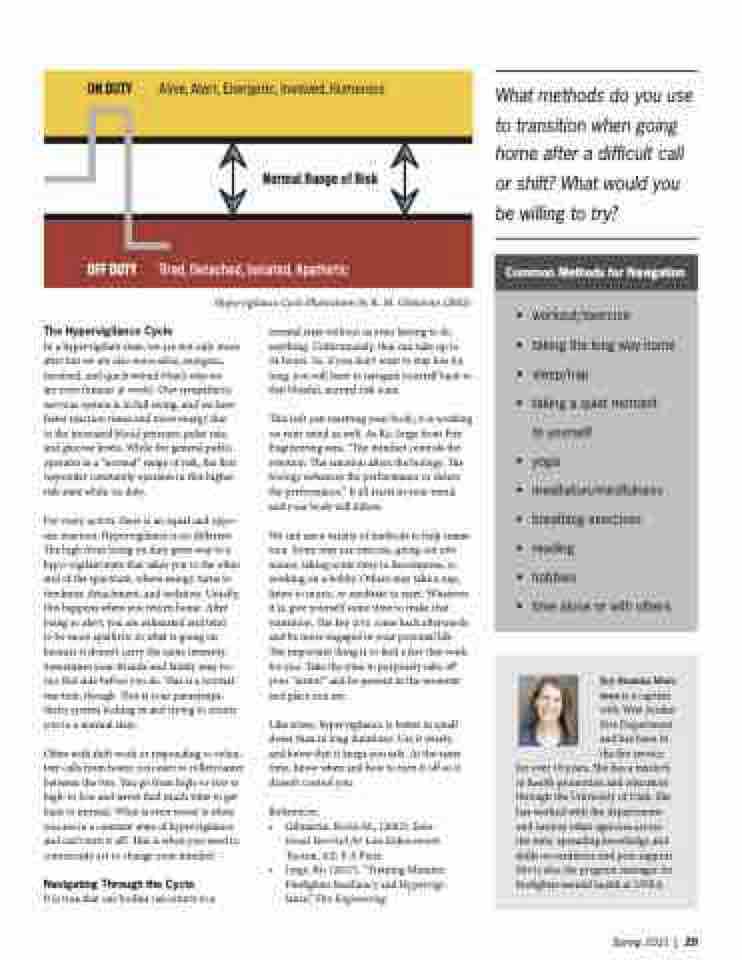
  ON DUTY Alive, Alert, Energetic, Involved, Humorous
           Normal Range of Risk
Hypervigilance Cycle illustrations by K. M. Gilmartin (2002)
What methods do you use to transition when going home after a difficult call or shift? What would you be willing to try?
        OFF DUTY Tired, Detached, Isolated, Apathetic
  Common Methods for Navigation
 • workout/exercise
• taking the long way home
• sleep/nap
• taking a quiet moment
to yourself
• yoga
• meditation/mindfulness
• breathing exercises
• reading
• hobbies
• time alone or with others
The Hypervigilance Cycle
In a hypervigilant state, we are not only more alert but we are also more alive, energetic, involved, and quick witted (that’s why we
are even funnier at work). Our sympathetic nervous system is in full swing, and we have faster reaction times and more energy due
to the increased blood pressure, pulse rate, and glucose levels. While the general public operates in a “normal” range of risk, the first responder constantly operates in this higher risk state while on duty.
For every action, there is an equal and oppo- site reaction. Hypervigilance is no different. The high from being on duty gives way to a hypo-vigilant state that takes you to the other end of the spectrum, where energy turns to tiredness, detachment, and isolation. Usually, this happens when you return home. After being so alert, you are exhausted and tend
to be more apathetic to what is going on because it doesn’t carry the same intensity. Sometimes your friends and family may no- tice this side before you do. This is a normal reaction, though. This is your parasympa- thetic system kicking in and trying to return you to a normal state.
Often with shift work or responding to volun- teer calls from home, you start to rollercoaster between the two. You go from high-to-low to high-to-low and never find much time to get back to normal. What is even worse is when you are in a constant state of hypervigilance and can’t turn it off. This is when you need to consciously act to change your mindset.
Navigating Through the Cycle
It is true that our bodies can return to a
normal state without us even having to do anything. Unfortunately, that can take up to 24 hours. So, if you don’t want to stay low for long, you will have to navigate yourself back to that blissful, normal risk zone.
This isn’t just resetting your body; it is working on your mind as well. As Ric Jorge from Fire Engineering says, “The mindset controls the emotion. The emotion alters the biology. The biology enhances the performance or deters the performance.” It all starts in your mind, and your body will follow.
We can use a variety of methods to help transi- tion. Some may use exercise, going out into nature, taking some time to decompress, or working on a hobby. Others may take a nap, listen to music, or meditate to reset. Whatever it is, give yourself some time to make that transition. The key is to come back afterwards and be more engaged in your personal life. The important thing is to find a few that work for you. Take the time to purposely take off your “armor” and be present in the moment and place you are.
Like stress, hypervigilance is better in small doses than in long durations. Use it wisely, and know that it keeps you safe. At the same time, know when and how to turn it off so it doesn’t control you.
References:
• Gilmartin, Kevin M., (2002). Emo-
tional Survival for Law Enforcement.
Tucson, AZ: E-S Press.
• Jorge, Ric (2017). “Training Minutes:
Firefighter Resiliency and Hypervigi- lance,” Fire Engineering.
 Joy Stearns Mon- toya is a captain with West Jordan Fire Department and has been in the fire service
for over 16 years. She has a master’s in health promotion and education through the University of Utah. She has worked with fire departments and various other agencies across the state, spreading knowledge and skills on resilience and peer support. She is also the program manager for firefighter mental health at UFRA.
 Spring 2021 | 29


