


Page 25 - UFRA Straight Tip Spring 2021 - Volume 22 Issue 2
P. 25
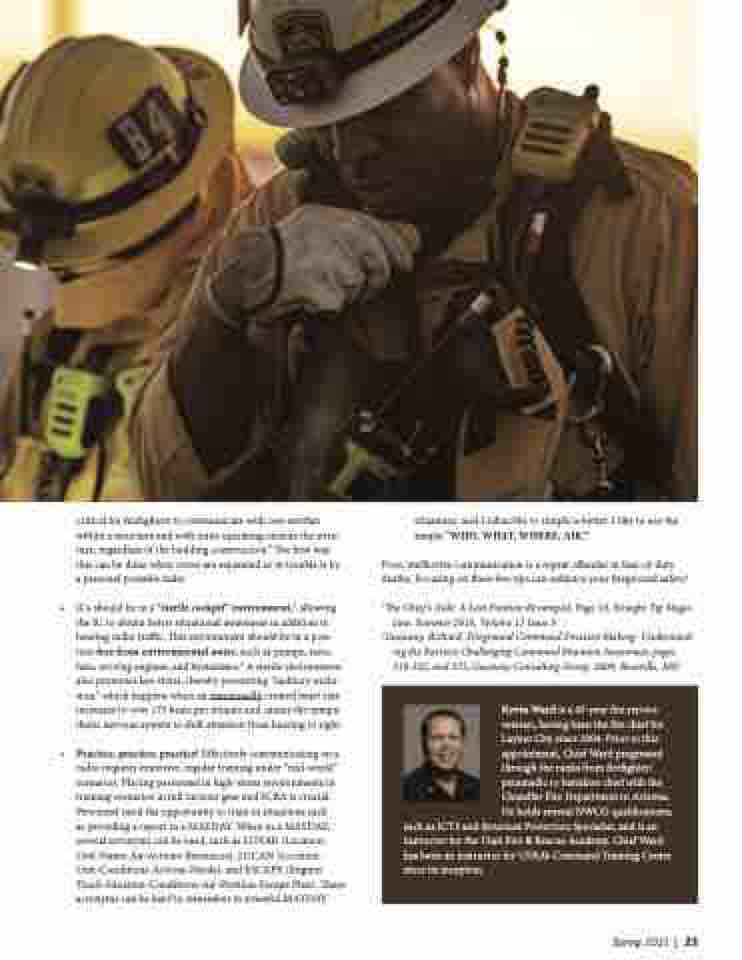
 critical for firefighters to communicate with one another within a structure and with units operating outside the struc- ture, regardless of the building construction.” The best way this can be done when crews are separated or in trouble is by a personal portable radio.
• ICs should be in a “sterile cockpit” environment,1 allowing the IC to obtain better situational awareness in addition to hearing radio traffic. This environment should be in a posi- tion free from environmental noise, such as pumps, saws, fans, revving engines, and bystanders.2 A sterile environment also promotes less stress, thereby preventing “auditory exclu- sion,” which happens when an emotionally created heart rate increases to over 175 beats per minute and causes the sympa- thetic nervous system to shift attention from hearing to sight.
• Practice, practice, practice! Effectively communicating on a radio requires extensive, regular training under “real-world” scenarios. Placing personnel in high-stress environments in training scenarios in full turnout gear and SCBA is crucial. Personnel need the opportunity to train in situations such
as providing a report in a MAYDAY. When in a MAYDAY, several acronyms can be used, such as LUNAR (Location- Unit-Name-Air/Actions-Resources), LUCAN (Location- Unit-Conditions-Actions-Needs), and ESCAPE (Engine/ Truck-Situation-Conditions-Air-Position-Escape Plan). These acronyms can be hard to remember in stressful MAYDAY
situations, and I subscribe to simple is better. I like to use the simple “WHO, WHAT, WHERE, AIR.”
Poor, ineffective communication is a repeat offender in line-of-duty deaths. Focusing on these few tips can enhance your fireground safety!
1The Chief ’s Aide: A Lost Position Revamped, Page 10, Straight Tip Maga- zine, Summer 2016, Volume 17 Issue 3
2Gasaway, Richard, Fireground Command Decision Making- Understand- ing the Barriers Challenging Command Situation Awareness, pages 319-322, and 375, Gasaway Consulting Group, 2009, Roseville, MN
 Kevin Ward is a 43-year fire service veteran, having been the fire chief for Layton City since 2004. Prior to this appointment, Chief Ward progressed through the ranks from firefighter/ paramedic to battalion chief with the Chandler Fire Department in Arizona. He holds several NWCG qualifications,
such as ICT3 and Structure Protection Specialist, and is an instructor for the Utah Fire & Rescue Academy. Chief Ward has been an instructor for UFRA’s Command Training Center since its inception.
  Spring 2021 | 23


