


Page 9 - UFRA Straight Tip Spring 2021 - Volume 22 Issue 2
P. 9
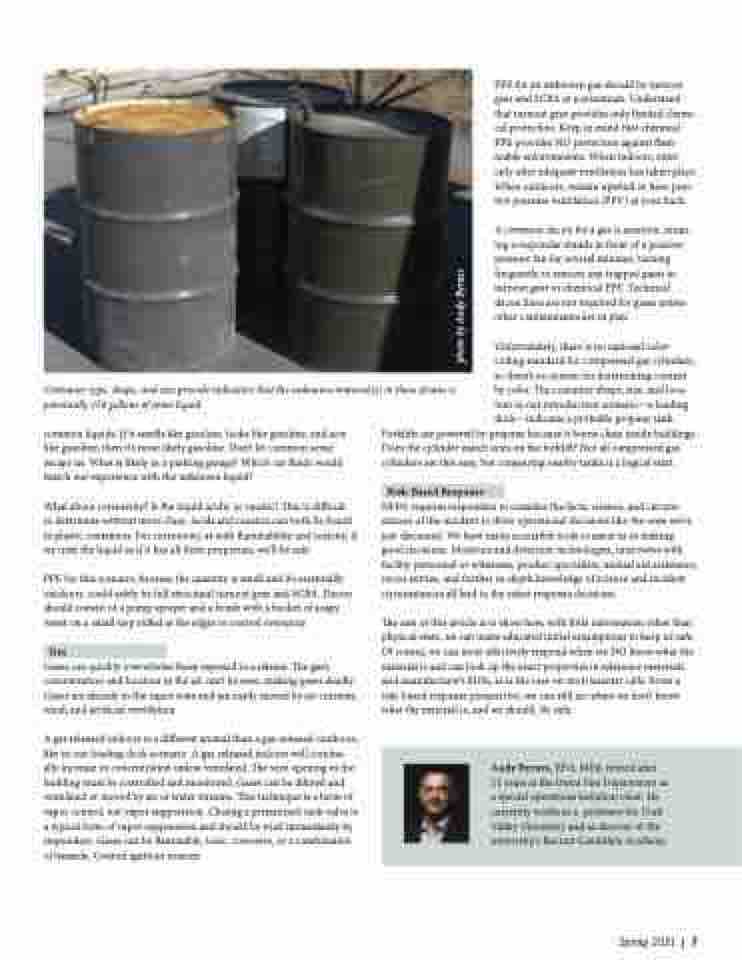
 Container type, shape, and size provide indicators that the unknown material(s) in these drums is potentially 150 gallons of some liquid.
PPE for an unknown gas should be turnout gear and SCBA at a minimum. Understand that turnout gear provides only limited chemi- cal protection. Keep in mind that chemical PPE provides NO protection against flam- mable environments. When indoors, enter only after adequate ventilation has taken place. When outdoors, remain upwind or have posi- tive pressure ventilation (PPV) at your back.
A common decon for a gas is aeration, mean- ing a responder stands in front of a positive pressure fan for several minutes, turning frequently to remove any trapped gases in turnout gear or chemical PPE. Technical decon lines are not required for gases unless other contaminants are in play.
Unfortunately, there is no national color- coding standard for compressed gas cylinders, so there’s no system for determining content by color. The container shape, size, and loca- tion in our introduction scenario—a loading dock—indicates a probable propane tank.
common liquids. If it smells like gasoline, looks like gasoline, and acts like gasoline, then it’s most likely gasoline. Don’t let common sense escape us. What is likely in a parking garage? Which car fluids would match our experience with the unknown liquid?
What about corrosivity? Is the liquid acidic or caustic? This is difficult to determine without more clues. Acids and caustics can both be found in plastic containers. For corrosivity, as with flammability and toxicity, if we treat the liquid as if it has all these properties, we’ll be safe.
PPE for this scenario, because the quantity is small and it’s essentially outdoors, could safely be full structural turnout gear and SCBA. Decon should consist of a pump sprayer and a brush with a bucket of soapy water on a small tarp rolled at the edges to control overspray.
Gas
Gases can quickly overwhelm those exposed to a release. The gas’s concentration and location in the air can’t be seen, making gases deadly. Gases are already in the vapor state and are easily moved by air currents, wind, and artificial ventilation.
A gas released indoors is a different animal than a gas released outdoors, like in our loading dock scenario. A gas released indoors will continu- ally increase in concentration unless ventilated. The vent opening in the building must be controlled and monitored. Gases can be diluted and ventilated or moved by air or water streams. This technique is a form of vapor control, not vapor suppression. Closing a pressurized tank valve is a typical form of vapor suppression and should be tried immediately by responders. Gases can be flammable, toxic, corrosive, or a combination of hazards. Control ignition sources.
Forklifts are powered by propane because it burns clean inside buildings. Does the cylinder match ones on the forklift? Not all compressed gas cylinders are this easy, but comparing nearby tanks is a logical start.
Risk-Based Response
NFPA requires responders to consider the facts, science, and circum- stances of the incident to drive operational decisions like the ones we’ve just discussed. We have easily accessible tools to assist us in making good decisions. Monitors and detection technologies, interviews with facility personnel or witnesses, product specialists, mutual aid assistance, recon entries, and further in-depth knowledge of science and incident circumstances all lead to the safest response decisions.
The aim of this article is to show how, with little information other than physical state, we can make educated initial assumptions to keep us safe. Of course, we can most effectively respond when we DO know what the material is and can look up the exact properties in reference materials and manufacturer’s SDSs, as is the case on most hazmat calls. From a risk-based response perspective, we can still act when we don’t know what the material is, and we should. Be safe.
   Spring 2021 | 7
Andy Byrnes, EFO, MEd, retired after 21 years at the Orem Fire Department as a special operations battalion chief. He currently works as a professor for Utah Valley University and as director of the university's Recruit Candidate Academy.
 photo by Andy Byrnes


