


Page 7 - UFRA Straight Tip Spring 2021 - Volume 22 Issue 2
P. 7
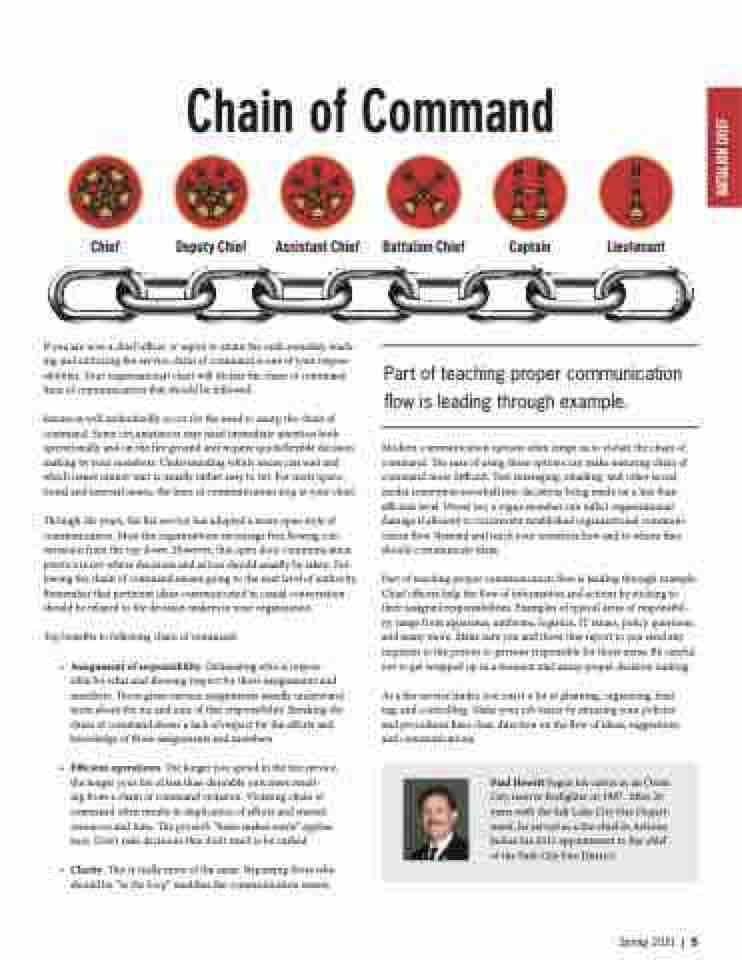
 Chain of Command
BATTALION CHIEF
If you are now a chief officer or aspire to attain the rank someday, teach- ing and enforcing fire service chain of command is one of your respon- sibilities. Your organizational chart will dictate the chain of command lines of communication that should be followed.
Instances will undoubtedly occur for the need to usurp the chain of command. Some circumstances may need immediate attention both operationally and on the fire ground and require quick/flexible decision making by your members. Understanding which issues can wait and which issues cannot wait is usually rather easy to vet. For most opera- tional and internal issues, the lines of communication stop at your chief.
Through the years, the fire service has adopted a more open style of communication. Most fire organizations encourage free flowing con- versation from the top down. However, this open door communication practice is not where decisions and action should usually be taken. Fol- lowing the chain of command means going to the next level of authority. Remember that pertinent ideas communicated in casual conversation should be relayed to the decision makers in your organization.
Top benefits to following chain of command:
• Assignment of responsibility. Delineating who is respon- sible for what and showing respect for those assignments and members. Those given various assignments usually understand more about the ins and outs of that responsibility. Breaking the chain of command shows a lack of respect for the efforts and knowledge of those assignments and members.
• Efficient operations. The longer you spend in the fire service, the longer your list of less than desirable outcomes result-
ing from a chain of command violation. Violating chain of command often results in duplication of efforts and wasted resources and time. The proverb “haste makes waste” applies here. Don’t rush decisions that don’t need to be rushed.
• Clarity. This is really more of the same. Bypassing those who should be “in the loop” muddies the communication waters.
Part of teaching proper communication flow is leading through example.
Modern communication options often tempt us to violate the chain of command. The ease of using these options can make ensuring chain of command more difficult. Text messaging, emailing, and other social media sometimes snowball into decisions being made on a less than efficient level. Worse yet, a rogue member can inflict organizational damage if allowed to circumvent established organizational communi- cation flow. Remind and teach your members how and to whom they should communicate ideas.
Part of teaching proper communication flow is leading through example. Chief officers help the flow of information and actions by sticking to their assigned responsibilities. Examples of typical areas of responsibil- ity range from apparatus, uniforms, logistics, IT issues, policy questions, and many more. Make sure you and those that report to you send any inquiries to the person or persons responsible for those areas. Be careful not to get wrapped up in a moment and usurp proper decision making.
As a fire service leader, you enact a lot of planning, organizing, lead- ing, and controlling. Make your job easier by ensuring your policies and procedures have clear direction on the flow of ideas, suggestions, and communications.
Paul Hewitt began his career as an Orem City reserve firefighter in 1987. After 20 years with the Salt Lake City Fire Depart- ment, he served as a fire chief in Arizona before his 2011 appointment to fire chief of the Park City Fire District.
Spring 2021 | 5


