


Page 5 - UFRA Straight Tip Spring 2021 - Volume 22 Issue 2
P. 5
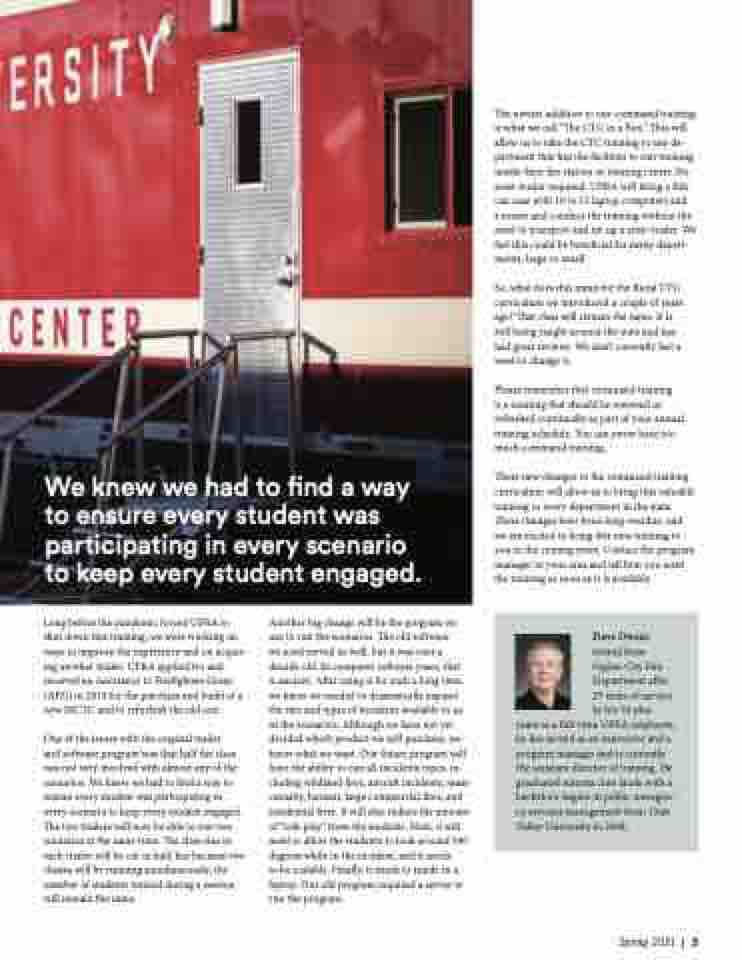
 We knew we had to find a way to ensure every student was participating in every scenario to keep every student engaged.
The newest addition to our command training is what we call “The CTC in a Box.” This will allow us to take the CTC training to any de- partment that has the facilities to run training inside their fire station or training center. No semi-trailer required. UFRA will bring a Peli- can case with 10 to 15 laptop computers and
a router and conduct the training without the need to transport and set up a semi-trailer. We feel this could be beneficial for many depart- ments, large or small.
So, what does this mean for the Rural CTC curriculum we introduced a couple of years ago? That class will remain the same. It is still being taught around the state and has had great reviews. We don’t currently feel a need to change it.
Please remember that command training
is a training that should be renewed or refreshed continually as part of your annual training schedule. You can never have too much command training.
These new changes to the command training curriculum will allow us to bring this valuable training to every department in the state. These changes have been long overdue, and we are excited to bring this new training to you in the coming years. Contact the program manager in your area and tell him you want the training as soon as it is available.
 Dave Owens
retired from Ogden City Fire Department after 27 years of service. In his 10-plus
years as a full-time UFRA employee, he has served as an instructor and a program manager and is currently the assistant director of training. He graduated summa cum laude with a bachelor’s degree in public emergen- cy services management from Utah Valley University in 2008.
 Long before the pandemic forced UFRA to shut down this training, we were working on ways to improve the experience and on acquir- ing another trailer. UFRA applied for and received an Assistance to Firefighters Grant (AFG) in 2019 for the purchase and build of a new MCTC and to refurbish the old one.
One of the issues with the original trailer
and software program was that half the class was not very involved with almost any of the scenarios. We knew we had to find a way to ensure every student was participating in every scenario to keep every student engaged. The two trailers will now be able to run two scenarios at the same time. The class size in each trailer will be cut in half, but because two classes will be running simultaneously, the number of students trained during a session will remain the same.
Another big change will be the program we use to run the scenarios. The old software
we used served us well, but it was over a decade old. In computer software years, that
is ancient. After using it for such a long time, we knew we needed to dramatically expand the size and types of incidents available to us in the scenarios. Although we have not yet decided which product we will purchase, we know what we want. Our future program will have the ability to run all incidents types, in- cluding wildland fires, aircraft incidents, mass- casualty, hazmat, large commercial fires, and residential fires. It will also reduce the amount of “role play” from the students. Next, it will need to allow the students to look around 360 degrees while in the incident, and it needs
to be scalable. Finally, it needs to reside in a laptop. Our old program required a server to run the program.
Spring 2021 | 3


